
In the ever-evolving landscape of education, understanding the diverse capabilities of students is paramount. The theory of Multiple Intelligences, introduced by Howard Gardner in 1983, revolutionizes how we perceive intelligence and learning. This theory suggests that intelligence is not a monolithic capability measured solely by IQ tests, but a plurality of distinct skills and abilities. Here, we explore the facets of Multiple Intelligences (MI) and their transformative impact on educational practices.
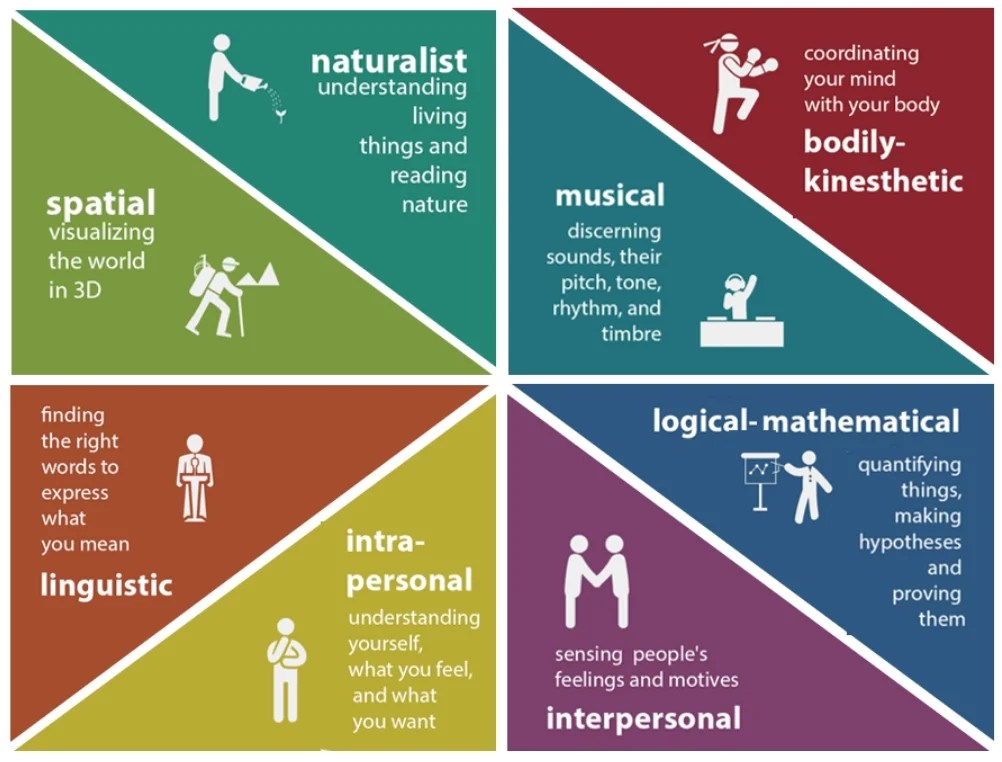
The Eight Intelligences: A Broader View of Capability
Gardner initially identified seven intelligences, later expanding to eight, each representing a different way of processing information:
- Linguistic Intelligence: The capacity to use words effectively, whether orally or in writing. It is prevalent among writers, poets, and journalists.
- Logical-Mathematical Intelligence: The ability to analyze problems logically, carry out mathematical operations, and investigate issues scientifically. Mathematicians and scientists excel in this intelligence.
- Spatial Intelligence: The potential to think in three-dimensional terms. Pilots, sculptors, and architects often have high spatial intelligence.
- Musical Intelligence: The skill to discern, create, and reproduce music. Musicians, composers, and music teachers exhibit this intelligence.
- Bodily-Kinesthetic Intelligence: The capability to use one’s physical body skillfully. Athletes, dancers, and surgeons are typically strong in this area.
- Interpersonal Intelligence: The ability to understand and interact effectively with others. Teachers, social workers, and actors might excel here.
- Intrapersonal Intelligence: The capacity to understand oneself and one’s thoughts and feelings, and to use such knowledge in planning and directing one’s life.
- Naturalist Intelligence: The ability to recognize and categorize plants, animals, and other items in nature. This intelligence is crucial for biologists and environmentalists.
Transformative Educational Practices
The concept of Multiple Intelligences has profound implications for how education is delivered. It challenges the traditional, one-size-fits-all approach to teaching and proposes a more personalized and diversified educational experience. Here are some ways MI theory can be integrated into educational practices:
- Personalized Learning Paths: Understanding that students have different strengths allows educators to tailor learning experiences according to each student’s dominant intelligence. This could mean more hands-on learning for bodily-kinesthetic learners or discussion-based learning for those with high interpersonal intelligence.
- Interdisciplinary Approaches: MI theory encourages the blending of subjects. For example, teaching mathematical concepts through music rhythms or exploring physics through dance helps bridge different intelligences.
- Enhanced Engagement and Motivation: When students are engaged in ways that align with their intelligence profiles, they are more likely to be motivated and excited about learning. This leads to deeper understanding and retention of knowledge.
- Inclusive Education: MI theory advocates for inclusivity. By recognizing all types of intelligences as equal, the educational system can appreciate and cultivate the diverse talents of all students, not just those who excel academically.
The Road Ahead
While the theory of Multiple Intelligences is not without its critics, it continues to inspire educators around the world to think differently about intelligence and learning. The key takeaway is the recognition of individual strengths and the potential to foster an education system that celebrates this diversity. By doing so, we not only create a more equitable educational environment but also empower students to maximize their unique potentials.
In conclusion, the theory of Multiple Intelligences invites us to reconsider our definitions of intelligence and to adopt a more holistic, personalized approach to education. As we embrace this broader spectrum of human capabilities, we pave the way for a future where every individual’s potential is acknowledged and nurtured.





Leave a Reply